I'll no longer be posting here on this Blogger platform and have migrated the content to WordPress - in the hopes that it's a better experience for readers. You can access the new site by visiting:
The Daily ReTORt

- Tor Constantino
- I'm no longer posting here. Visit my new blog -> WWW.THEDAILYRETORT.COM
Showing posts with label fusion. Show all posts
Showing posts with label fusion. Show all posts
Tuesday, November 1, 2011


Monday, October 31, 2011
NEW BLOG SITE LAUNCHES TOMORROW!!!
Starting tomorrow, this blog will re-launch as a completely different web log. It's new web address will be www.thedailyretort.com.
It will continue to feature the same types of topical writing you've come to expect from me, but the site itself will look completely different and will have a lot more to offer readers.
Here's a sample of what the new "header" for the blog will look like:

So be sure to subscribe at the new site -> www.thedailyretort.com!!!

Friday, October 28, 2011
Amazing Perseverance...by a 10-Year Old
 |
| The Same Poster My Daughter Used When She Lost Last Year, But Won This Year, Hung in Her Room |
But that's not what makes me proud of her.
What makes me proud is that the photo insert you see pictured here to the left "Taylor C. for VP" hung in her room for the past several months when she LOST the very same race for Vice President last year.
Even though she lost the election back then, she believed in herself and persevered to win now. While the accomplishment is good, it's her character that's truly inspiring.
If you're interested, you can click on the "read more" link below for the original post from November 16, 2010 I wrote about her loss, and how she handled it with grace and maturity beyond her years.
Wednesday, October 26, 2011
5 Productivity Pitfalls Learned From Marathon Training
 |
| Running Along - courtesy www.ronedmondson.com |
Today I have the honor of having a featured guest post on the fantastic web site of Ron Edmondson, a nationally-recognized writer, pastor and leadership authority.
Ron was kind enough to publish a piece I wrote titled 5 Productivity Pitfalls Learned From Marathon Training - here's an excerpt:
========================================
Prior to my 40th birthday I decided I wanted to run a full marathon. I found a training regimen, stuck to it and successfully completed my first 26.2 mile distance within the top half of finishers for my age group – with energy to spare!
That experience for me was akin to successfully finishing a large project at my job – on time, under budget with the desired positive result. I then decided that “marathoning” would be my hobby. I followed the same plan for five months and had a similar outcome with my second full marathon.
Then things changed.
Six months later I ran my third marathon. It took me nearly seven hours to finish – that was more than three hours longer than my fastest race – a productivity loss of more than 40 percent. I was one of the last people to cross the finish line. Every joint and muscle in my body ached. Plus, I was 20 pounds heavier running the third race than the previous ones.
What happened? I allowed my past successes to undermine my future objectives. Specifically, I fell into five productivity pitfalls that led to my diminished performance.....
========================
To read the rest of my guest post - visit www.ronedmondson.com.
7 Questions With an Author: Salvatore Manzi

He's a successful business owner, author and presenter. Not only do we both share the same first name and passion for Italian cuisine, we both believe in life maximization.
Here's "7 Questions With an Author: Salvatore Manzi"
1. Tell us about your book?
Feng Shui Life Mapping: Master the Art of Designing Your Future combines the ancient Chinese art of Feng Shui and the power of the Vision Board to create a visual representation of your "bucket list." Your Life Map serves a reminder of your dreams, focusing your attention and energy to ensure their speedy arrival. Your Life Map can also be used to redesign your home or work space with simple, easy to follow suggestions to have your entire home act as a visual affirmation of who you are, who you want to be, and where your life is going.
2. What led you to write it?
At a low-point in my life - a dead-end job, a broken relationship, a huge debt and a depressing hole of an apartment - a friend gave me a book on Feng Shui. I began changing my home and soon my life changed with it. Combining the Feng Shui principles with my visual bucket list, I began to experience what can only be called miraculous things - whatever image I put on the Life Map came true! I then took my Life Map one step further and used it to Feng Shui my apartment and within 3 months, I was out of debt and on my way to fulfilling a life-long dream of living in Italy with a job, apartment and visa waiting for me. When I returned, I began teaching Feng Shui Life Mapping and after three years and dozens of workshop, the book was published.
3. Who is a writer that inspires you and why?
I've always been a fan of Jack Kerouac for his rambling narrative style that captured both his adventures as well as meaningful insights throughout his travels. Daniel Quinn, Alberto Villodo, Gregg Braden and Shakti Gawain convey essential truths to living a good life and inspire me to commit each day to being a messenger of love on this planet. Perhaps my favorite two fiction writers are Patrick Suskind (Perfume) and Tom Spanbauer (The Man who Fell in Love with the Moon) for their visual and prosaic writing style.
4. What was the biggest challenge you faced writing this book?
Honestly, each step along has had its challenges! Each time I think the hardest part is over, the next phase comes and presents a whole new set of possibilities and difficulties. Probably the most challenging aspect involved creating the cover design, with conflicting input from the publisher and graphic designers and such. There came a time when I just had to let go and trust others with my baby, and the results were incredible.
5. What advice would you give to an aspiring writer?
Write every day! Writing is both talent and skill, and the skill can be developed and refined so that the talent will express itself naturally. The most important part of writing is developing your voice and that comes from experimenting with different styles. One of my biggest challenges was giving myself permission to write junk. I've written a lot of junk. But the thing about writing every day is that somewhere along the way, a gem appears.
6. Where do you get your ideas?
I read a lot! I read books, magazines, blogs, newspapers... If I read a line that catches my attention, I make a note of it on my iPhone. And the next day I use that line as a launch pad for my morning writing. Sometimes I will sit down and type out whole paragraphs of an author's work and then turn the page and try playing with their rhythm to see what comes out of me.
7. Anything that you'd like readers to know that I haven't asked?
The best advice I've ever received was from a teacher who told me to study everything that everyone else had to say on the matter... and then do my own thing.
Bio:
Feng Shui Expert, Author, and Presenter, Salvatore Manzi, has been studying the environment's impact on life for over 25 years. Fascinated by foreign cultures, Salvatore has moved 75 times across 3 continents and 14 cities experiencing first hand the varied energetic benefits and challenges of living spaces from urban-high-rise condos to remote forest cabins. Salvatore's book shows how simple shifts in one’s environment can lead to a transformational experience on every level. With easy to use suggestions, he helps you discover how your environment hinders or supports your dreams.
If you'd like to learn more about Salvatore you can visit his web site at http://fengshuilifemapping.com/ or check out his book Feng Shui Life Mapping: Master the Art of Designing Your Future.
Question: What area of your life might benefit from applying a discipline such as Feng Shui?
Friday, October 21, 2011
10 Comebacks I Wish I Would Have Said....
We've all been there. A social, business or public setting where someone says something or asks a question that leaves us stammeringly speechless. Then hours later we think of the perfect retort to the remark or comment, and we say to ourselves, "I wish I would have said that."
As the proverb goes, "An apt reply is as gold."
In no particular order, here are 10 such replies that I wish I had said, that I plan to use going forward:
Question: What's your favorite response to an unwelcome comment, insult or question?
As the proverb goes, "An apt reply is as gold."
In no particular order, here are 10 such replies that I wish I had said, that I plan to use going forward:
- "If you'll forgive me for not answering, I'll forgive you for asking."
- "I believe it's better to be silent and thought a fool, than to open your mouth and reveal all doubt - as you have chosen to do here."
- "Well as you know, there is no legislating against ignorance."
- "Since we’re obviously saying whatever crosses our minds tonight, I’d like to say how much I hate this topic."
- "Congratulations, you've proven once again that you can't argue with crazy!"
- "You’re funny sometimes. Just not this time."
- "If I understood what you’re implying, I could answer you."
- "I would challenge you to a battle of wits, but I see that you are unarmed."
- "Your comment (question, behavior...) is a classic example for why some animals eat their young..."
- "If I were in your shoes, I'd probably feel the same way; however, it's hard to argue with someone who is agreeing with you."
Question: What's your favorite response to an unwelcome comment, insult or question?
Wednesday, October 19, 2011
7 Questions With an Author: Tamara Gerlach

Tamara bought her first business, Encore Gymnastics, Dance and Climbing in 1989. A former National Team Coach, Junior Olympic Program Committee Member, and Member of the Board of Directors for USA Gymnastics, she has been involved in sports as a competitive athlete, coach, choreographer, and judge.
She began life and business coaching in 2001 and obtained her training through the Coaches Training Institute, as well as completing leadership training through Coactive Space. Here are "7 Questions With an Author: Tamara Gerlach"
Monday, October 17, 2011
The Catchiest Song of All-Time (so says science)
It's happened to all of us. We hear a song and then we're humming it all day and can't get it out of our minds. According to a recent study out of the University of London, there's a scientific reason for it.
According to a recent news release issued by the university, music psychologists have identified the scientific properties that give certain melodies the 'sing-along-able' factor.
The research monitored the behaviour of thousands of people as they sang along to more than a thousand tunes. The fieldwork, undertaken by expert musicologist Dr. Alisun Pawley and Dr. Daniel Mullensiefen, from the Department of Psychology, uncovered the common traits in songs that are most 'catchy'.
According to a recent news release issued by the university, music psychologists have identified the scientific properties that give certain melodies the 'sing-along-able' factor.
The research monitored the behaviour of thousands of people as they sang along to more than a thousand tunes. The fieldwork, undertaken by expert musicologist Dr. Alisun Pawley and Dr. Daniel Mullensiefen, from the Department of Psychology, uncovered the common traits in songs that are most 'catchy'.
Thursday, October 13, 2011
Women Speak More Goodly Than Guys
 |
| Women have a genetic gift for gab! |
The headline of this blog post shouldn’t come as much of a surprise to anyone, in fact the best communicators I’ve known in my professional and personal live have all been the fairer sex – just ask my wife!
In fact, the past 13 or so years that I’ve been in corporate communications all of my bosses have been women - and they've typically been some of the best communicators within the various organizations.
That fact comes to bear in two recent studies I recently read. The first was conducted by Stanford University researcher Diane McGinness, who gave young children a series of 12 different tasks to accomplish and recorded any subsequent vocalizations that the kids made.
Wednesday, October 12, 2011
7 Questions With an Author: Karen H. Sherman, PhD.

This is my weekly series titled 7 Questions With an Author... where I pose seven questions to an author and then share their unedited answers here.
Today's author is Dr. Karen Sherman who is a licensed psychologist who focuses on relationships. In her own words here's part of her mission as a counselor:
I work with people in a number of ways - in private practice, teaching college courses, and now more "public" education through my books and other products. I truly believe that anyone has the power to change their life, regardless of what their past has been. And I am honored when I can help someone in that process!
Karen's latest addition to that process is her book Mindfulness and The Art of Choice - and here are 7 questions to help you learn more.
Tuesday, October 11, 2011
Newsroom Secrets Revealed - Part 2
 |
| Credibility = Walter Cronkite |
- Credibility is the single most important attribute that a news organization has.
- Technology is an inescapable part of delivering and consuming news.
- Many news organizations undermine their credibility by over-using or abusing technology.
In my blog post yesterday titled Newsroom Secrets Revealed - Part 1 I shared two secrets that typical television news consumers don't typically know or consider.
Here are two more.....
Monday, October 10, 2011
My Guest Post on FaithVillage.com
 |
| This is the logo for the new web site www.faithvillage.com |
The site contains a wide array of topical content that ranges from culture, inspiration and leadership. Here's an excerpt of my article on leadership.
==========================================
There is a weakness that nearly every leader shares, whether they lead a Fortune 500 company, non-profit organization, sports team or family. But it’s not as obvious or clear cut as poor time management, lackluster decision-making abilities or subpar interpersonal skills. While this particular weakness plagues virtually every leader, it can go unnoticed and unaddressed for years because of its inherent nature.
It’s the inability of the leader to identify their own blind spot(s).
By definition a blind spot is something that someone can’t readily identify or acknowledge for various reasons, which often means that it’s a developmental area that goes unobserved and uncorrected. While blind spots are not unique to leaders, the trappings of leadership (e.g. success, responsibility, stress, workload . . . etc.) may further obscure the blind spots of a leader. Despite that nearly universal shortcoming, here are four ways that a leader can help identify their own potential blind spots.
Be sure to visit www.faithvillage.com to read the rest of the article
Newsroom Secrets Revealed - Part 1
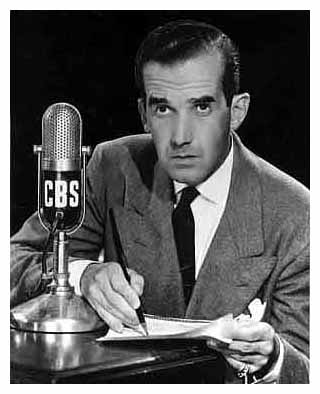 |
| Newscaster Edward R. Murrow: "Just the Facts" |
During my 20+ years as a communications professional, I've worked in more than a dozen television, radio and print newsrooms. Most television viewers and news consumers tend to believe that if they see it on T.V. it must be true.
However, the truth of the matter is that seeing does not always mean believing - especially when it comes to broadcast news.
During the early days of television news when there were broadcasting pioneers on the air such as Edward R. Murrow, Chet Huntley and Walter Cronkite the actual news content was very straight forward.
The story was what it was, and it was called "hard news." It was sometimes dry - downright boring by today's standards - but it was essentially fact-driven.
The reality today is that the facts alone do not drive the story.
With technological advancements that include the use of green screens, full motion graphics, virtual newscasters and animation; today's television newscast is a hybrid between information and entertainment also known as "info-tainment."
Any news director or news producer who supports this particular genre of journalism usually defends it vehemently on the grounds that news needs to compete for the viewers' attention against a host of other options (i.e. movies, game shows, music...etc.) Based on that kind of competitive pressure, it is rationalized, that the news needs to be made more appealing or attractive.
However, the issue arises around the application of the technology that's used to dress up T.V. news - leading back to the premise of this article that seeing is not always believing.
There are several "tricks" and tactics that routinely occur during the typical local/national newscast that the average viewer is not aware of, which include:
1. LOOK-LIVE REPORTS - this is a common practice at local news stations where a reporter pre-records their story at the scene of a given event. The pre-recorded video is then beamed back or driven to the station. The newscaster then introduces the reporter as "joining us live from the scene...."
The problem is the report was pre-recorded, it's not live. Actual live transmissions from the field are only possible using costly satellite trucks with the report being carried over the airwaves in real time. Look-Live Reports are used when the live trucks are not available, but the news team wants to appear omnipresent. Ironically, the viewer may not know the difference between a pre-recorded Look-Live Report and an actual Live Report.
2. NODDING REPORTERS – this occurs all the time in local news. It’s where a pre-recorded story runs that’s been filed by a general assignment reporter, featuring an on-camera interview with a newsmaker. During the broadcast story of the newsmaker’s remarks, a 3-5 second video snippet of the reporter silently nodding their head, is spliced over top of the video of the newsmaker’s spoken words and then the video seamlessly cuts back to the newsmaker.
The issue with this tactic is that local reporters are sent on stories with a single videographer who has one camera. As such, the videographer can only tape one thing at a time. They’ll usually tape the interview first and then they’ll tape “cut aways” of the reporter nodding their head, the reporter writing on a notepad or looking intently at the newsmaker – sometimes after the newsmaker has left the scene. Sometimes the "cut aways" are shot hours later. The trickery occurs back at the studio where the individual elements are edited together to give the appearance of a cohesive multi-camera interview, which actually never occurred.
Television news crews, management and consultants justify these subtle mis-directions claiming that viewers won't watch otherwise. Tomorrow, I'll share two more technology secrets that television newsrooms use that may or may not undermine their credibility.
Question: What's more important to you the viewer - the facts or the packaging of the news you consume?
Wednesday, October 5, 2011
7 Questions With an Author: Cameron Conaway, Warrior Poet

Today's author is Cameron Conaway who has come to be known as "The Warrior Poet." He teaches Shakespeare for Ottawa University, is an award-nominated teacher of creative writing for Johns Hopkins Center for Talented Youth, was the University of Arizona's 2007-2009 Poet-in-Residence and received the Richard Russo Award for Creative Writing. But Conaway is more than a poet, he's a warrior - literally.
He's an NSCA-Certified Personal Trainer and is undefeated (2-0) in the 155 lbs. weight class as a mixed martila arts (MMA) fighter. Cameron has trained with Brazilian Jujitsu master Renzo Gracie and is now studying Muay Thai in Thailand under sponsorship from www.WhatsYourFight.com.
His book Caged: Memoirs of a Cage-Fighting Poet , is the true story of a young man who overcomes a family background and his own inner torment by learning to channel his frustrations into the physical world of mixed martial arts fighting and the cerebral world of poetry and writing.
Here is 7 Questions With Author: Cameron Conaway
==================================================
1. Tell us about your book?
It’s about the power of then. It’s about a young boy who struggled through a difficult divorce and abuse. He’s a former mixed martial arts (MMA) fighter from conservative central Pennsylvania who had three fights, acted in a play and went to graduate school for poetry. He is me. Readers will learn about poetry tools like iambic pentameter and enjambment as well as the transverse abdominis muscle and the complexities of a fighter’s mind.
2. What led you to write it?
I am obsessed with MMA and poetry and I had a story of overcoming within myself. Writing this book took five years and each day it developed from a yarn-ball of tension and frustration that ultimately gave way to understanding and forgiveness. As award-winning writers and mentors saw interconnecting threads throughout my essays they encouraged me to weave a book out of them. Those mentors believed this book could help other people and would be a unique contribution to the literary field, so I went for it.
3. Who is a writer that inspires you and why?
I’ve got an Allen Ginsberg quote tattooed on my thigh. It reads: “The only thing that can save the world is the reclaiming of the awareness of the world.” We’ve lost our awareness of the world so I’ve taken his torch (or some fire from it) and am using what skills I have to help us reclaim our lost awareness. Ginsberg stood on train tracks where weapons of murder were being delivered and said “Ohm” into a microphone as a form of protest - he pushed the boundaries of peace and poetry.
4. What was the biggest challenge you faced writing this book?
An unexpected lawsuit threat and the ripple of drama it caused. There are usual and expected hardships that every writer must face - the critical thinking over the course of years, the editing, the rejection letters and pursuit of a publisher and agent and yada-yada-yada was expected and happens to most writers. But to have your dream publisher (Tuttle Publishing) accept your work, to work with them for a year on it and then - precisely when the book is available for pre-order - to have them cancel the contract because of lawsuit threats from a stepmother I haven’t talked to since I was a little boy? That was something no writer can truly be prepared for.
5. What advice would you give to an aspiring writer?
Balance this: Find motivation from wherever you can – inspiring people or organizations or stories – but also be a doomer and by that I mean be prepared for the worst. It’s good to have high hopes, but when high hopes aren’t tempered with a doomer mindset the writer is setting themselves up to be crushed in a way that may be difficult to recover from. To be any good at this craft, writers must be sensitive. A smart writer will realize this sensitivity can swing like a pendulum and they’ll prepare ahead of time.
6. Where do you get your ideas?
If it’s interesting I’ll think about. If it also hits me emotionally I’ll write about it. Beyond that I have no idea.
7. Anything that you'd like readers to know that I haven't asked?
I’d like thank my sponsor WhatsYourFight.com. They’ve given a small-town dude the chance to live and train Muay Thai kickboxing here in Thailand. Check out their work – they are helping loads of people achieve their personal goals.
================================================
Some interesting insights from a uniquely dualistic perspective....you can find out more about Cameron Conaway at his site http://cameronconaway.com/
Question: What's an area of your life were you have had to reconcile seemingly opposite issues?
Wednesday, September 28, 2011
7 Questions With an Author: Jim McBride, Movie Producer of Fireproof & Courageous

Today's author is Jim McBride he's the executive producer of the films released by Sherwood Pictures, including Courageous, Fireproof, Facing the Giants, and Flywheel. His first book is titled Rite of Passage: A Father's Blessing.
Here is 7 Questions With Author: Jim McBride
===================================
1. What is your book about?
My book, Rite of Passage: A Father's Blessing, is about the journey my wife and I have gone through of blessing our four children through a ceremony that calls out the man and woman in my sons and daughters and culminates with me praying a prayer of blessing over their life as a father. The book also gives a practical description for the ceremony that the reader can adapt for their family to make it personal to them. The average age for my children for this ceremony was 16, but I close the book by telling a story of how my father blessed me in my late 30's as a challenge to parents that it is never too late to bless your children.
2. What led you to write it?
I read a book by Robert Lewis called Raising A Modern Day Knight, that talked about the process that he used to raise his sons. In the book, he mentions the importance of a ceremony that he conducted with his sons. I was also inspired by a number of adult men and women who I have talked with who have shared with me their longing for their father's approval and blessing. This inspired me and my wife to begin to pray about how we could do something not just for our sons, but for our daughters as well, in order to send our kids out to the world from a position of approval, rather than seeking approval.
3. Who is a writer who inspires you and why?
Warren Wiersbe is an author who inspires me. Firstly, because of his volume of work having written on every book of the Bible, and over 175 books total. Secondly, he inspires me because of his command and depth of knowledge of Scripture. Another author that inspires me is Chuck Swindoll because he has a way of making the most complex things easy to understand and keeps a grasp of the reader from beginning to end.
4. What is the biggest challenge you faced writing this book?
As executive pastor of a large church, as well as the responsibility of being executive producer of the films of Sherwood Pictures, finding the time to break away from the day-to-day duties and responsibilities was my biggest challenge. Because of this, I am tremendously grateful for Tom Neven, who helped me with the writing process.
5. What advice would you give to an aspiring writer?
Research, research, research! Look for a good editor. Also, if God lays something on your heart to put on the paper, never give up until it's done.
6. Where do you get your ideas?
I am an avid reader and read between 100 and 150 books a year. When I am not reading, I like to think about the ways that things that I am reading tie together. This allows me to come up with many ideas, one of which is my book, Rite of Passage: A Father's Blessing.
7. Anything that you would like readers to know that I did not ask you?
There is a Rite of Passage Facebook page if you would like to see more people's comments as well as a personal blog that you can follow at www.jimmcbrideblog.com.
===========================================
** LOOK **: Be sure to comment below and either tweet this on Twitter or share it on Facebook to be entered into a drawing to receive a FREE copy of Jim's Book!
Monday, September 26, 2011
Is Your Member of Congress Corrupt??
 |
| Sen. David Vitter (LA) allegedly bribed the Secretary of the Interior |
In fact, Gallup's most recent Honest and Ethics survey of professionals found that congressional representatives and senators rank third from the bottom above car salespersons and congressional lobbyists.
Congress has a glaring perception problem and another survey released last week makes it even worse.
The Citizens for Responsibility and Ethics in Washington (CREW) just released its annual list of the 19 most corrupt members of Congress. You can access the entire report by clicking here that goes into details but here's the list of corrupt congressional members identified by CREW in no particular order:
- Charles Bass (R-NH)
- Vern Buchanan (R-FL)
- Stephen Fincher (R-TN)
- Michael Grimm (R-NY)
- Frank Guinta (R-NH)
- Gregory Meeks (D-NY)
- Nick Rahall (D-WV)
- Laura Richardson (D-CA)
- David Rivera (R-FL)
- Hal Rogers (R-KY)
- Jean Schmidt (R-OH)
- Joe Walsh (R-IL)
- Maxine Waters (D-CA)
- David Vitter (R-LA)
- Joe Barton (R-TX)
- Shelley Berkley (D-NV)
- Sanford Bishop (D-GA)
- Jeff Denham (R-CA)
- Eddie Bernice Johnson (D-TX)
On the Democratic side, the FBI seems to be looking at Rep. Gregory Meeks (D-NY) for accepting gifts from campaign donors and Rep. Nick Rahall (D-WV) made the list for letting his lobbyist sister trade on his name.
While there are 435 members of Congress and these 19 represent four percent - that's simply unacceptable.
Question: Is your congressional representative/senator listed above? What should congressional leadership do to enforce its own ethics policies?
Wednesday, September 21, 2011
7 Questions With an Author: Alice Chan, Ph.D.

Today's author is Dr. Alice Chan, a former professor at Cornell University and current inspirational speaker, author and coach. Her most recent book is titled Reach Your Dreams: Five Steps to be a Conscious Creator in Your Life.
Here is 7 Questions With Author: Alice Chan
===============================================
1. Tell us about your book?
REACH Your Dreams: Five Steps to be a Conscious Creator in Your Life outlines my five-step system for helping you get clear on what you want, eliminate barriers on your path to your desires and take inspired action toward creating what you want. It guides you to leverage both your rational mind and intuitive wisdom to create the life of your dreams. Most of all, REACH is a process that works for you, no matter where you are in your life and what you are ready to do.
Tuesday, September 20, 2011
Top-10 List: Traffic Pet Peeves
 |
| Stock Photo of a DC-area Traffic Jam |
However, this post is not about me and my road rage fantasies - it's about all the other idiots driving on the road.
Here in the greater Washington, DC area there seems to be a disproportionate number of idiot drivers (IDs) per square foot of asphalt. As such, here's a list of my top-10 Driving Pet Peeves:
10. Tailgating - I'm not sure why expressway drivers are compelled to hug my bumper like they're drafting my slipstream at Daytona International Speedway; however, when I'm driving alone, I'm half tempted to spike my brakes and make this would-be rear ender learn a lesson via higher insurance premiums.
9. Slow Driving in the Passing Lane - I don't endorse speeding but the passing lane is intended for fast driving. The drivers who are oblivious to this fact and insist on driving 40 mph in the fast lane are even more dangerous than speeders and should be stripped of driving privileges and relegated to mass transit.
8. Passing Car Cuts in Front, then Slows Down - This particular driving practice is a step worse than those slowpokes who unintentionally clog the fast lane. Here the passer drives at an alarming high-rate of speed to only to cut in front of you or some other unsuspecting "passee" and then the passer slows down. I don't condone road rage - but I understand it when this occurs.
7. Chronic Lane Shifting - While there are no traffic laws being violated with this one, the driver who constantly moves lanes jockeying for a single space advancement in the traffic mosh pit deserves a 3 iron to the windshield courtesy of road rage poster child Jack Nicholson.
6. Speeding Through a Round About - Round abouts are those circular sections of pavement at a four-way stop that are alternatives to traffic lights and are supposed to facilitate pavement flow. Unfortunately, that is based on the assumption that drivers who enter the round about are not trying to qualify for the Indy 500.
5. Rolling "Non-Stop" at a Four-Way Stop - Drivers who roll through stop signs are either ignorant or passive aggressive. Whether intentional or not, their slow roll ignores the rule of the road that the first driver to stop at the intersection has the right of way. At times like that I half wish I was a heavy equipment operator on a steam roller to do a bit of a slow roll of my own across their hood.
4. Blowing Through Yield Signs - I'm at a loss for words regarding this reckless practice, so I'll yield the floor to the immortal words of Arthur Fonzirelli from Happy Days, "What are you NUTSO???"
3. Passing on the Shoulder - Grrrrr. This is one of the most dangerous roadway practices - yet I see it happen on a weekly basis where someone summarily decides that the narrow shoulder of the highway is their personalized driving lane. That's when I half wish I was the crazed, shoulder-pad-wearing-mohawk-coiffed motorcyclist from Road Warrior wielding a studded baseball bat to spike their tires.
2. Talking/Texting on a Mobile Phone While the Car is Moving - Hey I know you're super important and that world leaders need constant connection, seeking your 24/7 sage advice to rectify critical issues such as global warming; domestic job creation; the economic meltdown as well as alternate fuel sources but do us all a favor - hang up and drive with both hands while your vehicle is in motion!!!
1. No Turn Signal - This ultra-dangerous highway epidemic wouldn't bother me if I had only passed that undergraduate course in MIND READING!!! Unfortunately I failed that course and still can't cipher the inner intent of another person, especially when they want to "Tokyo Drift" their two-ton street legal projectile in front of me with no turn signal. Argh!!
Deep cleansing breaths - out with the bad air, in with the good...much better.
Question: What highway shenanigans drive you crazy?
Friday, September 16, 2011
Book Review: 31 Days to Finding Your Blogging Mojo

 I've been a professional writer (journalist and public relations guy) for more than 23+ years, but I'm a relative newbie in the realm of blogging and the blogosphere in general.
As such, I'm continually on the hunt for new books that will help me improve as a blogger.
I've found a great one in Bryan Allain's new e-book, 31 Days to Finding Your Blogging Mojo currently available at Amazon as well as Barnes & Noble.com.
As background, Allain has been an expert blogger since 2001 and he writes daily doses of humor and inspiration at BryanAllain.com. He also offers resources and coaching tips to bloggers at KillerTribes.com. Additionally, his writing has appeared in print in RELEVANT Magazine and COLLIDE Magazine and online at Stuff Christians Like, The Burnside Writers Collective, and The Daily Beast.
Wednesday, September 7, 2011
7 Questions With an Author: Greg Wientjes, Ph.D.

 This is my weekly series titled 7 Questions With an Author... where I pose seven questions to an author and then share their unedited answers here.
Today's author is a Standford University Ph.D. holder, Greg Wientjes. Greg currently conducts research in the area of collaborative teaching and learning in online digital environments.
He holds a Bachelor’s degree in Mathematics and a Master’s degree in Electrical Engineering from Stanford University. Greg is also the cofounder and CEO of University Post, Inc., an Internet content company focused on college campuses.
Pretty impressive credentials, I know. His new book Creative Genius in Technology
 is a collection of 14 essays based on interviews that Greg conducted with various "geniuses." Here's an excerpt description.
"...In these stories, you will discover that these geniuses are not so different than you. With hard work, the right type of education and a bit of happenstance, you too can achieve the massive levels of creativity and impact on the world these geniuses attained.
Change the world! Make a difference! Listen to the stories within this book and discover your own genius within just waiting to escape and shine for the world."
Here's 7 Questions With an Author: Greg Wientjes, Ph.D.
===============================================
1. Tell us about your book?
Creative Genius in Technology is a book version of my doctoral dissertation. In this book I have interviewed some of the the world’s most famous geniuses. These individuals are known for their achievements and perfect strategies in their careers, including Tim Berners-Lee (Father of the World Wide Web, MIT Professor); Doug Osheroff (Nobel Prize in Physics, Stanford Professor of Physics); Bob Metcalfe (Father of the Ethernet, National Medal of Technology) as well as several others.
2. What led you to write it?
I wanted to share my knowledge and experience of talking to some of the world's most intelligent people with those who would not normally have such access. I have included those interviews within my Ph.D. thesis, which is not publicly available - so the book affords that opportunity.
3. Who is a writer that inspires you and why?
My mentors at Stanford University are the people who were (and continue to be) the source of inspiration for me to research and compile those findings into a book.
4. What was the biggest challenge you faced writing this book?
Well, the biggest challenge is letting people know that this resource exists and that it's not restricted to college classrooms. This is a book that everyone should read, who's every wondered about how geniuses live and think. It's pretty fascinating.
5. What advice would you give to an aspiring writer?
Be confident and write whatever you think is worth writing.
6. Where do you get your ideas?
By Brainstorming.
7. Anything that you'd like readers to know that I haven't asked?
I would like readers to know that every human being has some hidden potentials. The only thing which is required, is to discover what those are and then polish them to make them brighter and more evident for others to see. This book helps show how others have done just that, providing a resource for others who want to blaze a trail of their own.
=================================================
Deepest thanks to Greg Wientjes for sharing insights into his book. If you're interested in more of Greg's work, he has written and published other papers. You can view summaries of those articles by clicking HERE.
Question: What trail would you like to blaze? What's holding you back?
Subscribe to:
Posts (Atom)